I. Assessment Overview
This report evaluates Versus Trade's security posture and investor protection mechanisms across eight dimensions: trading platform security, KYC/AML compliance, client fund segregation, investor protection gaps, data security, account security measures, technical stability, and leverage risk analysis.
Versus Trade holds a Securities Trading License from the Financial Services Commission (FSC) of Mauritius and uses the MetaTrader 5 standard trading platform. The company claims to have implemented measures such as client fund segregation. However, in-depth analysis reveals serious deficiencies in data security transparency, investor compensation mechanisms, and the actual availability of advertised payment methods. The extreme 1:2000 leverage combined with a 0% stop-out level exposes investors to the risk of total capital loss.
Core Conclusion: Versus Trade meets basic industry standards at the hardware level (MT5 platform, Sumsub KYC), but exhibits systemic deficiencies at the software level (fund segregation transparency, security audits, investor compensation). Overall rating: HIGH RISK.
II. Trading Platform Security
2.1 MetaTrader 5 Full License
Versus Trade operates on MetaTrader 5 (MT5) Full License, confirmed by WikiFX. MT5 is one of the world's most widely used retail forex trading platforms, developed by MetaQuotes, featuring mature order management systems, advanced charting tools, and automated trading interfaces.
Using a standard third-party platform rather than proprietary software is a relatively positive signal. A common red flag among offshore scam platforms is the use of custom-built fake trading software — the interface may look professional, but the backend allows arbitrary manipulation of quotes, falsification of trading records, and blocking of withdrawals. As an industry-standard product, MT5's matching engine is uniformly maintained by MetaQuotes, limiting brokers' ability to manipulate the underlying trading logic.
2.2 Server Deployment
Versus Trade's website claims its servers are located in London. London is the global hub for forex trading, where most liquidity providers and electronic trading systems are hosted. If this claim is accurate, network latency between MT5 clients and the server would be minimal, supporting fast order execution.
However, this claim remains unverified by any independent party. The platform has not disclosed specific data center providers, network architecture, or latency test results. Investors cannot confirm whether their trading orders are genuinely executed in London or routed through other nodes.
2.3 Platform Security Rating
| Assessment Item | Status | Rating |
|---|
| MT5 Full License | Confirmed by WikiFX | Good |
| Non-proprietary Platform | Reduces manipulation risk | Good |
| London Server Location | Unverified independently | Unverified |
| Multi-platform Support | Desktop/Web/Android/iOS | Good |
III. KYC/AML Compliance Analysis
3.1 Sumsub Third-Party Verification
Versus Trade employs Sumsub as its identity verification provider. Sumsub is a well-known RegTech company serving major platforms including Exness and Binance. This indicates that Versus Trade's KYC technology selection meets basic industry standards.
3.2 Missing Compliance Documentation
However, compliance goes beyond using third-party tools. InvestExposure's investigation found that Versus Trade lacks an independent KYC Policy document — despite claiming to have an AML Policy, the absence of a dedicated KYC policy means that the procedures, standards, and trigger conditions for identity verification remain opaque to external parties.
3.3 Minimal Registration Process
More concerning is the registration process itself. Testing reveals that creating an account requires only selecting a country, entering an email address, and setting a password — no real name is required. This is fundamentally incompatible with the "Know Your Customer" principles mandated by Tier-1 regulators such as the FCA and ASIC. Although some KYC checks may be triggered at the withdrawal stage, the extremely low registration barrier objectively reduces the cost of money laundering and fraud.
Key Contradiction: The platform claims to have an AML Policy, yet registration does not require real-name verification and no KYC Policy document exists — a logical contradiction. A broker genuinely enforcing anti-money laundering policies cannot remain ignorant of client identities at the account opening stage.
IV. Client Fund Segregation
4.1 Segregation Claims
Versus Trade claims to segregate client funds in "multiple tier-1 banks." Client fund segregation is a fundamental measure to protect investors from broker insolvency risk — theoretically, even if the company goes bankrupt, client funds should not be used to settle corporate debts.
4.2 Critical Issues
However, this claim has serious deficiencies:
No specific bank names disclosed: Investors cannot verify whether funds are actually held in regulated banks
No segregation agreement details published: No third-party custodian agreement numbers, no annual audit reports
FSC Mauritius does not mandate segregated fund audits: Unlike the FCA's required annual client money audit reports, offshore regulation provides virtually no enforcement on this matter
"Tier-1 bank" definition is vague: What constitutes "tier-1"? Systemically important banks or simply commercial banks?
In the absence of independent audits and specific banking information, "client fund segregation" remains nothing more than an unverifiable marketing claim. Multiple third-party investigation bodies (BrokerWatchdog, ForexScamReviews28) have flagged this as a major risk indicator.
V. Investor Protection Gaps
This represents the most significant gap between Versus Trade and regulated brokers.
| Protection Mechanism | FCA/ASIC Regulated | Versus Trade (FSC Mauritius) |
|---|
| Investor Compensation Fund | FSCS covers GBP 85,000 | None |
| Leverage Cap | 1:30 | 1:2000 |
| Negative Balance Protection | Mandatory | Stop-out 0%, balance can reach zero |
| Annual Fund Audit | Mandatory | None |
| Loss Client Ratio Disclosure | ESMA Mandate | None |
| Dispute Arbitration | Financial Ombudsman | No Independent Arbitration |
| Insurance Coverage | Partial | None |
This means: if Versus Trade goes bankrupt, absconds, or refuses withdrawals, investors have no external body to turn to. There is no compensation fund, no mandatory arbitration, no regulatory intervention — investor fund security relies entirely on the business reputation of an offshore company that has been operating for only about one year.
VI. Data Security
Data security is another critical dimension in evaluating a trading platform's safety. Investigation reveals that Versus Trade's information disclosure in this area is virtually nonexistent:
No independent security audit reports: No third-party penetration testing reports or security certifications (e.g., ISO 27001, SOC 2) have been found
No data encryption standards published: It is unknown whether client data is encrypted with AES-256 at rest or whether TLS 1.3 is used for transmission
SSL certificate details undisclosed: While the website uses HTTPS, the specific certificate type (DV/OV/EV), issuing authority, and validity period have not been disclosed
No data breach contingency plan: No data breach notification process or incident response plan has been published
By comparison, FCA-regulated brokers must meet stringent cybersecurity requirements, including regular penetration testing, incident response plans, and data protection impact assessments. Versus Trade's silence on these matters is itself a risk signal.
VII. Account Security Measures
Versus Trade has implemented some basic account security measures:
3D Secure Payment Verification: Card deposits are verified through the 3D Secure protocol, adding a layer of security to the payment process
OTP Withdrawal Verification: Withdrawal requests require one-time password verification to prevent unauthorized withdrawal requests
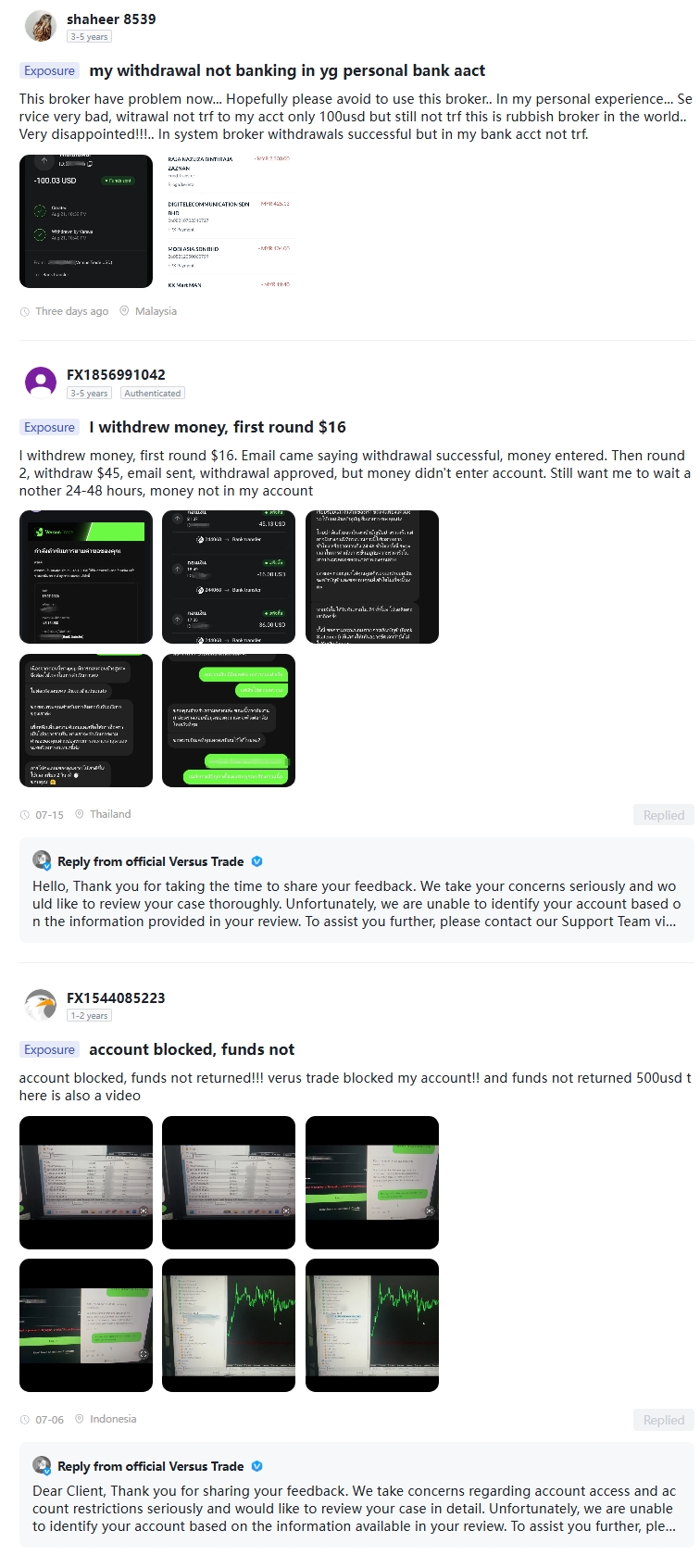
These measures represent industry standards and are commendable. However, it is important to note that account security depends not only on technical measures but also on the platform's integrity. If a platform can arbitrarily freeze accounts and cancel profits (as documented in WikiFX complaints), then no matter how sophisticated the login security, users' control over their funds remains out of their own hands.
VIII. Technical Stability Issues
GlobeGain's user review revealed a serious but often overlooked security dimension — technical stability risk:
Key Events Reported by Users:
XAUUSD (Gold) spread surged from a normal 12 pips to 500 pips
Order execution delayed by 3-5 minutes
Client disconnected from the trading server
These issues resulted in user losses exceeding $3,000
A gold spread surge from 12 pips to 500 pips (approximately 40x increase) is extremely rare under normal market conditions. This could be caused by:
Liquidity provider disconnection (LP outage)
Platform risk management system malfunction
Market-making engine failure
Excessive triggering of automatic spread widening mechanisms during extreme market conditions
Regardless of the cause, a 500-pip gold spread means investors incur massive floating losses the moment they open a position — this is unacceptable on any legitimate platform. Combined with 3-5 minute order delays and server disconnections, investors are virtually unable to perform any effective risk management operations during such technical failures.
More notably, under 1:2000 leverage with 0% stop-out conditions, additional slippage and delays caused by technical failures could result in complete account balance wipeout — this is not merely a technical risk but a systemic threat to fund security.
IX. 1:2000 Leverage & Stop-out 0% Risk
9.1 Leverage Comparison
| Jurisdiction | Leverage Cap | Description |
|---|
| ESMA (EU) | 1:30 | Statutory cap for major forex pairs |
| FCA (UK) | 1:30 | Same standard maintained post-Brexit |
| ASIC (Australia) | 1:30 | Implemented since 2021 |
| Japan | 1:25 | Among the strictest globally |
| Versus Trade | 1:2000 | 66.7x the EU cap |
9.2 Practical Impact
1:2000 leverage means $10 in margin can control a $20,000 position. Using EUR/USD as an example, an adverse move of approximately 3 basis points (roughly 0.0003) is sufficient to cause total margin loss. In actual trading, due to spreads, slippage, and volatility, this ratio becomes even more lethal.
A 0% stop-out means the platform will not proactively close positions when margin levels drop to a certain threshold — instead, it waits until the account balance reaches exactly zero before executing forced liquidation. This stands in stark contrast to the "negative balance protection" required by the FCA — under FCA regulation, even if extreme market volatility causes losses exceeding the account balance, investors will not owe the broker additional funds. Versus Trade's 0% stop-out means investors can lose their entire capital in an instant, with no buffer whatsoever.
Risk Quantification: Using a Standard account with $10 minimum deposit and 1:2000 leverage, EUR/USD needs to move only approximately 3-5 basis points to trigger stop-out. Under normal market volatility, this level of movement can occur within seconds. Combined with the aforementioned technical stability issues (3-5 minute delays, server disconnections), investors have virtually no opportunity for self-rescue during extreme market conditions.
X. Regulatory Protection Level Comparison
The following compares protection levels across different regulatory frameworks from the perspective of core investor protection dimensions:
| Protection Dimension | FCA (UK) | ASIC (Australia) | ESMA (EU) | FSC Mauritius |
|---|
| Minimum Capital Requirement | $500K+ | AUD 1M+ | EUR 730K+ | Lower requirements |
| Investor Compensation | GBP 85,000 | Compensation scheme | EUR 20,000 | None |
| Leverage Restriction | 1:30 | 1:30 | 1:30 | No limit |
| Negative Balance Protection | Mandatory | Mandatory | Mandatory | None |
| Fund Segregation Audit | Annual mandatory | Annual mandatory | Annual mandatory | Not required |
| Dispute Resolution | Financial Ombudsman | AFCA | FIN-NET | No independent mechanism |
| Regulatory Enforcement | Strong | Strong | Strong | Weak |
As an offshore regulator, the FSC Mauritius differs fundamentally from Tier-1 regulatory bodies in terms of resources, capacity, and enforcement willingness. BrokerWatchdog noted that the FSC registry does not even include Versus Trade's trading name or website address — investors cannot even directly confirm the legal association between the license holder and the Versus Trade brand.
XI. Comprehensive Assessment & Recommendations
Security Score Summary
| Assessment Dimension | Grade | Explanation |
|---|
| Trading Platform Security | B+ | MT5 Full License, non-proprietary, but server location unverified |
| KYC/AML Compliance | D | Uses Sumsub but lacks KYC Policy; registration does not require real name |
| Client Fund Segregation | D- | Claims segregation but no bank names disclosed; no audit reports |
| Investor Protection | F | No compensation fund, no arbitration mechanism, no insurance |
| Data Security | F | No security audit, no encryption standards, no SSL details |
| Account Security | C | Has 3DS and OTP, but high account freeze risk |
| Technical Stability | D- | 500-pip spread spikes, order delays, disconnection reports |
| Leverage Risk | F | 1:2000 leverage + 0% stop-out = extreme risk |
| Regulatory Protection | D | Offshore Tier-2/3 regulation; vast gap from Tier-1 regulators |
Final Recommendation: Versus Trade meets basic industry standards in trading platform selection (MT5 Full License), but its investor protection mechanisms exhibit systemic deficiencies. The combination of 1:2000 leverage and 0% stop-out means investors' capital faces a highly probable risk of total loss. The severe discrepancy between advertised and actual payment methods (cryptocurrency only) further undermines the platform's credibility. Investors are advised to prioritize brokers regulated by Tier-1 authorities such as FCA, ASIC, or ESMA, and to fully understand and accept the aforementioned risks before using Versus Trade.